FTSE Finish Line: July 7 — Shell Lifts London, But BoE Flags AI Leverage and Energy-Shock Risks
FTSE Finish Line: July 7 — Shell Lifts London, But BoE Flags AI Leverage and Energy-Shock Risks
The FTSE 100 edged higher on Tuesday, supported by a strong move in energy stocks as renewed tensions near the Strait of Hormuz pushed oil prices higher and Shell delivered a firmer second-quarter update. The benchmark climbed to a near four-month high in morning trade before paring some gains, as weakness in precious metals miners and caution around geopolitics limited the upside. Energy was the clear driver. The FTSE energy sub-index rose 1.9%, with Shell up 2.4% after the oil major raised its second-quarter gas production forecast and flagged significantly stronger gas trading compared with the previous quarter. BP added 0.9%, helped by the broader rise in crude prices.
Shell’s update mattered because it offered both operational and trading support. Stronger gas production improves the volume story, while better gas trading points to improved earnings momentum after a softer prior quarter. For the FTSE 100, Shell’s weight means that even a moderate rise in the stock can provide meaningful index support. Oil prices rose after reports of attacks on vessels near the Strait of Hormuz revived fears of disruption to shipping through one of the world’s most important energy transit routes. The reports came after a brief period in which markets had started to price less immediate supply risk following the Iran-war truce and increased Saudi tanker flows through Hormuz. Tuesday’s headlines reminded investors that the risk premium can return quickly.
The geopolitical backdrop remains fragile. Iran’s foreign minister said talks toward a final deal with Washington would not start if U.S. threats continue, following President Trump’s warning that the U.S. could “finish the job” if no deal is reached. That language kept markets alert to the risk of renewed escalation, especially with energy supply, shipping insurance and inflation expectations all sensitive to developments in the Gulf. For London, the effect is two-sided. Higher oil prices support Shell and BP and therefore help the FTSE 100. But they also complicate the Bank of England’s inflation problem. The central bank has already warned about delayed energy-price pass-through, with Governor Andrew Bailey saying rate cuts remain off the table for now despite softer activity. If energy prices rise again, the BoE’s wait-and-see stance becomes more difficult to loosen.
The Bank of England’s July 2026 Financial Stability Report added another layer of caution. The Financial Policy Committee warned that high investor borrowing in equity markets, particularly around AI-related companies, could amplify a market correction if expected productivity gains fail to materialise. In plain terms, the BoE is not only worried about expensive AI valuations; it is worried about expensive AI valuations financed with leverage. That is an important distinction. A normal equity correction hurts portfolios. A leveraged equity correction can transmit losses through lenders, prime brokers, funds and other parts of the financial system. If investors have borrowed heavily to buy AI-linked shares and the trade reverses sharply, forced selling could deepen the decline and turn a valuation reset into a credit event.
The implication for markets is that the AI rally is now being watched as a financial-stability issue, not just a growth story. That matters even for the FTSE 100, which has limited direct technology exposure. UK-listed miners, industrials, data companies and investment trusts have all benefited at times from the broader AI capex narrative. If regulators start focusing more closely on leverage behind the AI trade, global risk appetite could become more fragile. The FPC also highlighted energy and geopolitical shocks as key vulnerabilities. Ongoing conflict in the Middle East has created a negative supply shock for the global economy, keeping energy prices volatile and sovereign bond yields elevated. This links directly to Tuesday’s market action: the same Hormuz tensions that lifted Shell also raise the risk of stickier inflation, higher discount rates and weaker household purchasing power.
That makes the energy rally less straightforward than it looks. Higher crude and gas prices can boost index heavyweights in the short term, but they can also tighten financial conditions across the economy. For domestically exposed sectors, including housebuilders, retailers and banks, another energy shock would be a clear headwind. The report also flagged frontier AI models as a source of new operational and cybersecurity risk for the financial system. As banks and financial firms rely more heavily on advanced AI systems, they may face more frequent and disruptive software updates, model-risk failures, cyber vulnerabilities and third-party dependency risks. The message from the BoE is that AI is not just an asset-pricing story; it is becoming part of the financial system’s operating infrastructure.
For banks, the capital and leverage framework remains central. The FPC is reviewing bank capital requirements and leverage rules in response to the rise in investor leverage and broader market vulnerabilities. The system-wide Tier 1 benchmark sits around 13% of risk-weighted assets, after the FPC previously judged UK banks to be comfortably capitalised. Markets had been looking for reforms to the Additional Leverage Ratio Buffer and Countercyclical Leverage Ratio Buffer. The goal would be to reduce the frequency with which leverage requirements become the binding constraint for banks holding large amounts of lower-risk assets, especially as Basel 3.1 lowers average risk weights. Such changes could increase balance-sheet capacity, support lending and improve banks’ ability to intermediate gilt markets.
The implications are modestly constructive, but not risk-free. On the positive side, leverage-rule reform could support credit supply, market liquidity and outright gilt demand. That would help the UK at a time when elevated gilt yields remain a major constraint on fiscal policy and domestic valuations. On the negative side, the BoE’s broader warning about leveraged investors suggests regulators are not in a deregulatory mood across the whole system. They may ease constraints in one area while scrutinising leverage and market-based finance more aggressively elsewhere. Consumer-focused stocks were also among the strongest performers. Burberry, Diageo and Unilever rose between 3% and 3.7%, helping broaden the day’s gains beyond energy. The strength in these names suggested some investors were willing to rotate back into global consumer franchises after recent weakness, especially where valuations had become more attractive and earnings exposure is international rather than purely domestic.
That rotation was important because the domestic data backdrop remains uneven. Lloyds said British house prices rose 0.2% in June, the first monthly increase since February. That offered a modestly better signal after recent weakness in mortgage approvals, flat nationwide house-price data and a deeply contractionary construction PMI. However, Lloyds also warned that the outlook remains clouded by economic uncertainty, which keeps the housing recovery fragile. The housing data therefore helped sentiment only at the margin. A 0.2% monthly increase is better than another fall, but it does not erase the broader message from recent indicators: high borrowing costs, softer confidence and policy uncertainty are still restraining housing and construction activity.
On the downside, precious metals miners fell 1.9% as gold prices slipped under pressure from a stronger U.S. dollar. That weakness limited the FTSE’s advance and created a split within the broader resources complex. Energy stocks benefited from geopolitical risk, while gold miners suffered as dollar strength and reduced haven demand weighed on bullion. The market also kept an eye on defence and European security developments. NATO leaders began unveiling arms deals worth tens of billions of dollars in Turkey, reinforcing the message that European governments are responding to U.S. demands to spend more on defence ahead of a summit with President Trump. That theme remains supportive for defence-linked UK names over the medium term, including BAE Systems, Rolls-Royce and Babcock, even if individual daily moves remain uneven. Tuesday’s move came after Monday’s failed breakout, when the FTSE briefly touched a four-month high before slipping into negative territory following another weak construction PMI. The fact that the index again approached that high shows buyers remain present, but the repeated fading of early strength also suggests investors are not yet comfortable chasing the market aggressively.
Politics also remains a key background factor. The Labour leadership process is moving closer, with Andy Burnham still expected by markets to become prime minister. Investors are focused less on the leadership outcome itself and more on what follows: the choice of Chancellor, the fiscal framework, funding for major initiatives, union negotiations and any updated UK AI and industrial strategy. The AI angle is now especially relevant politically. Burnham’s team has reportedly been looking at a revamp of the UK’s AI strategy, but the BoE’s stability report shows the challenge: policymakers want AI-led productivity and investment, but regulators are increasingly alert to leverage, operational risk and bubble dynamics. The market will reward credible AI policy, but not if it appears to fuel speculative excess or financial instability.
Finish Line: The FTSE 100 edged higher as Shell’s stronger gas outlook and renewed Hormuz supply fears lifted energy stocks, offsetting weakness in precious metals miners. Consumer names such as Burberry, Diageo and Unilever added breadth to the rally, while a small rise in house prices offered limited comfort on the domestic backdrop. But the BoE’s Financial Stability Report added a clear warning: leveraged AI bets, volatile energy prices, elevated sovereign yields and frontier-AI cyber risks are now financial-stability concerns. The implication is that London’s rally remains headline-sensitive. Energy strength can lift the index today, but it can also keep inflation sticky tomorrow; AI optimism can support valuations, but leverage can turn a correction into a credit event.
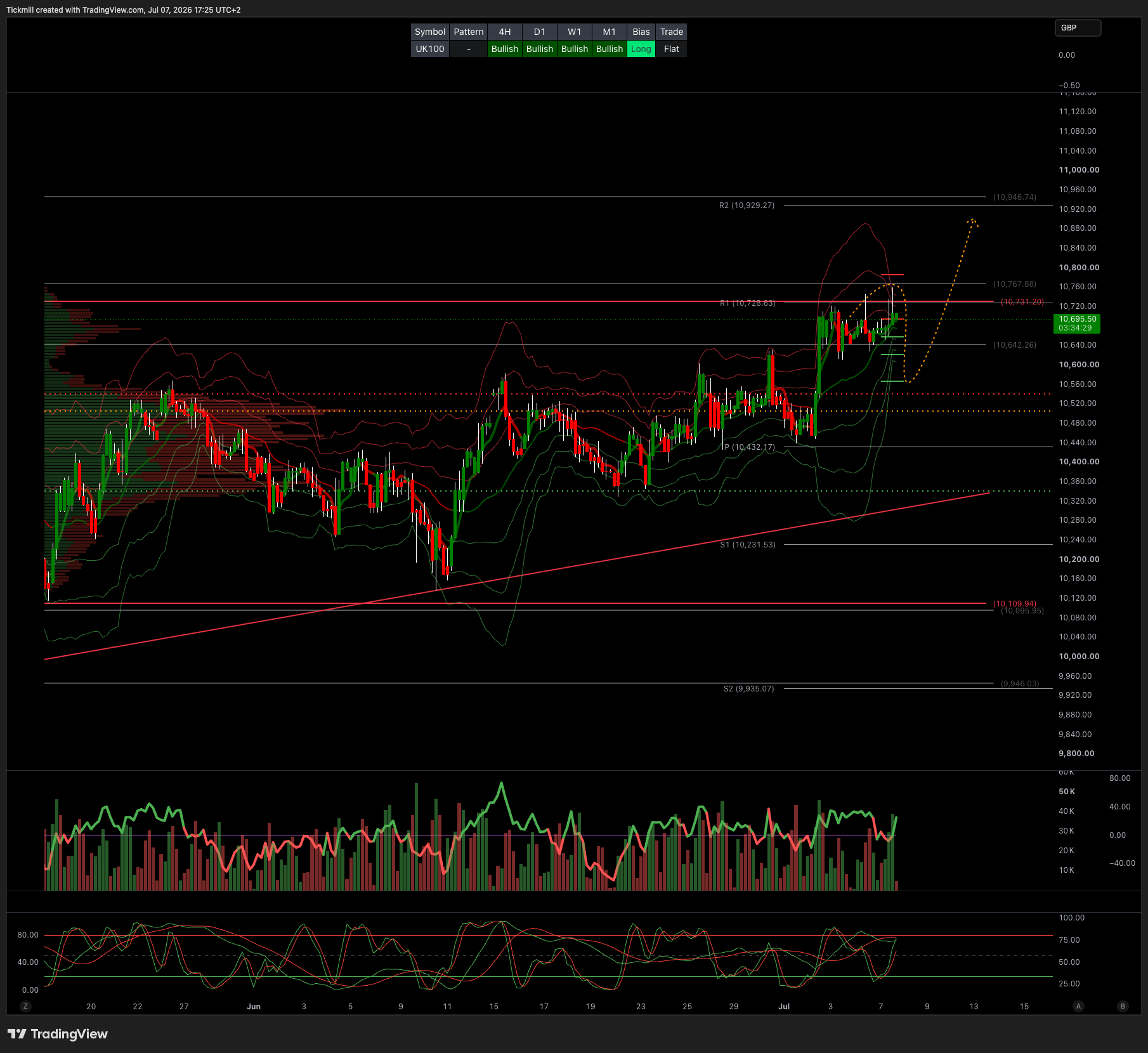
TECHNICAL & TRADE VIEW – FTSE100
Daily VWAP Bullish
Weekly VWAP Bullish
Above 10300 Target 11000
Below 10100 Target 9469
Disclaimer: The material provided is for information purposes only and should not be considered as investment advice. The views, information, or opinions expressed in the text belong solely to the author, and not to the author’s employer, organization, committee or other group or individual or company.
Past performance is not indicative of future results.
High Risk Warning: CFDs are complex instruments and come with a high risk of losing money rapidly due to leverage. 69% and 73% of retail investor accounts lose money when trading CFDs with Tickmill UK Ltd and Tickmill Europe Ltd respectively. You should consider whether you understand how CFDs work and whether you can afford to take the high risk of losing your money.
Futures and Options: Trading futures and options on margin carries a high degree of risk and may result in losses exceeding your initial investment. These products are not suitable for all investors. Ensure you fully understand the risks and take appropriate care to manage your risk.
Patrick has been involved in the financial markets for well over a decade as a self-educated professional trader and money manager. Flitting between the roles of market commentator, analyst and mentor, Patrick has improved the technical skills and psychological stance of literally hundreds of traders – coaching them to become savvy market operators!